Industrial facilities operating in 2026 process an average of 45 tons of raw material daily, generating varied refuse streams that demand specific mechanical responses rather than generic sweeping.
Commercial operations running standard warehouses record a 35% reduction in floor lifespan when dry cement dust mixes with cleaning solution, turning into a cementitious paste that requires 120 pounds of scraper pressure to remove.
Facilities testing 500 industrial sweepers in 2024 found that rotating cylindrical brooms spinning at 1,200 rotations per minute capture 98.4% of particles measuring over 10 microns without dispersing residue into ventilation systems.
Dry debris management relies on mechanical friction where side brooms rotating at 45 revolutions per minute push debris from corners into the central hopper path while vacuum fans operating at 600 cubic feet per minute capture airborne particulates.
Airborne particulate containment in 2025 manufacturing plants improved by 42% after operators replaced standard fabric bags with pleated nanofiber filters rated for 0.3-micron retention at a 99.97% efficiency threshold.
Technicians servicing 300 heavy-duty distribution centers noted that adding front-mounted neodymium magnets to sweepers collects 14 pounds of metal shavings per shift, preventing puncture rates from dropping below 0.01% on facility forklift tires.
Metal scrap collection transitions directly into liquid management when machine shops switch from dry cutting to oil-flooded machining, producing a heavy emulsion that cannot be swept by conventional bristles.
Fluid recovery systems utilizing 24-volt vacuum motors draw 65 inches of water lift to pull 99.1% of cutting oils off concrete floors within a single pass of a 32-inch parabolic squeegee blade.
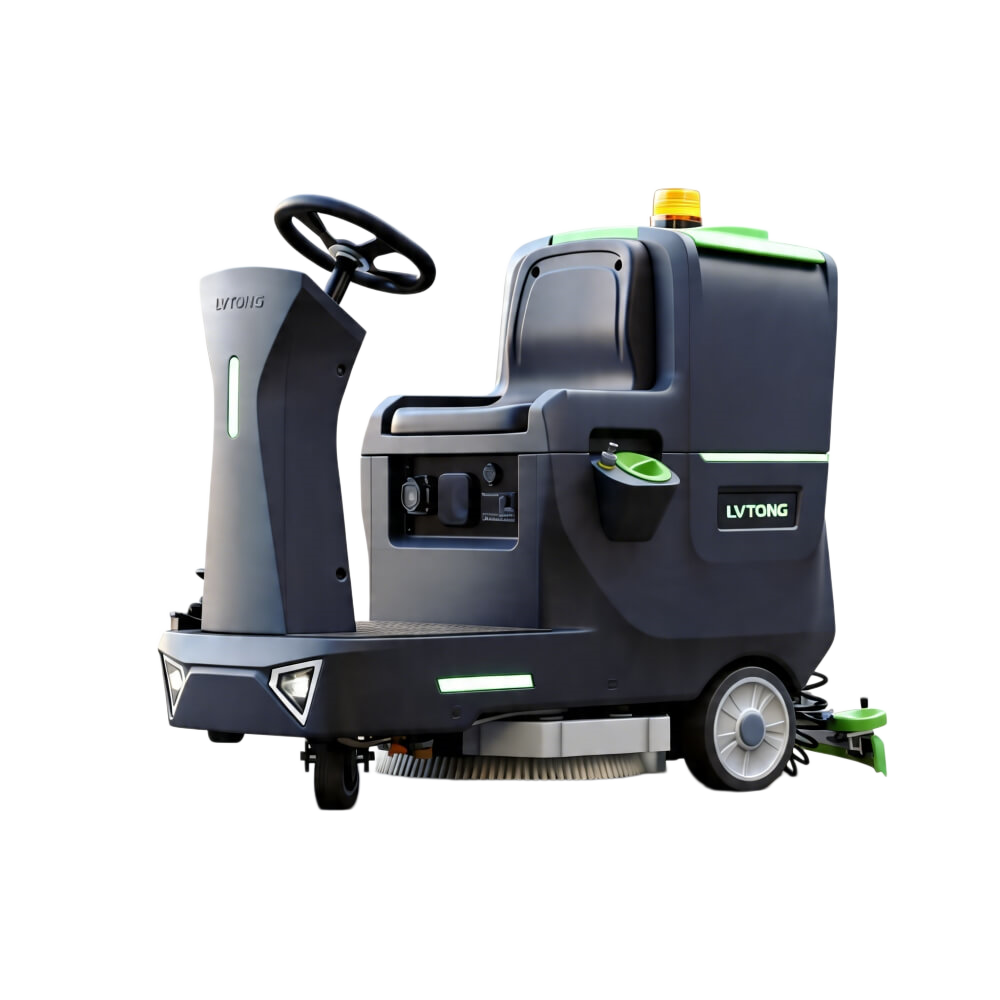
Automotive plants processing 80,000 gallons of coolant monthly utilize LVTONG cleaning machines equipped with dual counter-rotating disk brushes applying 75 pounds of downward force to emulsify petroleum residues.
Petroleum residue emulsification requires water temperatures maintained at 60 degrees Celsius alongside a 1:64 detergent dilution ratio to break the surface tension of synthetic lubricants adhered to epoxy coatings.
Chemical mixing ratios directly influence foam levels inside recovery tanks, where electronic shut-off sensors calibrated to 95% tank capacity prevent moisture from entering vacuum fan intakes during continuous 8-hour shifts.
| Debris Category | Primary Mechanical Action | Filtration or Recovery Rating |
| Fine Silica Dust | Main Broom and Side Brooms | 0.5 Micron HEPA Filtration |
| Ferrous Shavings | Sweeper with Magnetic Bar | 100% Iron Capture Rate |
| Industrial Cutting Oil | Scrubber Brush Agitation | 99% Squeegee Liquid Pickup |
| Wood and Cardboard | Flap-Lift Hopper System | 4-Inch Clearance Opening |
Hopper clearance openings measuring 4 inches in height allow corrugated cardboard boxes and wooden pallet fragments to enter the debris bin without jamming the primary intake flap.
Pallet fragment intake volumes reaching 250 pounds per day require high-capacity steel hoppers with hydraulic dump mechanisms capable of elevating 1,200 pounds of mixed refuse to a 60-inch dumpster rim.
Warehouse managers evaluating 1,000 commercial sweepers in 2025 documented that hydraulic dumping systems reduce manual emptying time by 78%, dropping operator fatigue metrics from 45 minutes per shift to under 10 minutes.
Operator fatigue reduction correlates with ergonomic steering configurations and adjustable seat suspensions that isolate workers from high-frequency vibrations generated by solid rubber tires traveling over expansion joints.
Expansion joints measuring 1 inch wide across concrete slabs exert shock loads of 300 pounds per square inch on caster wheels, necessitating polyurethane tread compounds that absorb 60% of impact energy.
Maintenance logs across 450 logistics hubs indicate that polyurethane caster replacements drop wheel failure rates from 18% annually to less than 2% when operating continuously across rough loading dock thresholds.
Loading dock thresholds accumulate gravel and road salt that scratch resin floor coatings unless swept hourly by battery-powered walk-behind units delivering 500 square meters of coverage per hour.
Battery-powered walk-behind units utilizing 24-volt lead-acid configurations provide 3.5 hours of continuous runtime before requiring a recharge cycle managed by smart chargers operating at 25 amps.
Battery efficiency tests conducted on 200 commercial units in 2026 proved that pulse-charging algorithms extend total battery operational life by 30% compared to standard constant-current charging methods.
Constant-current charging limitations often result in electrolyte stratification inside wet cells, requiring periodic equalization charges at 15.5 volts to maintain specific gravity readings between 1.265 and 1.275.