Three Machines Under One Roof: A Fee Audit at 192 TH/s
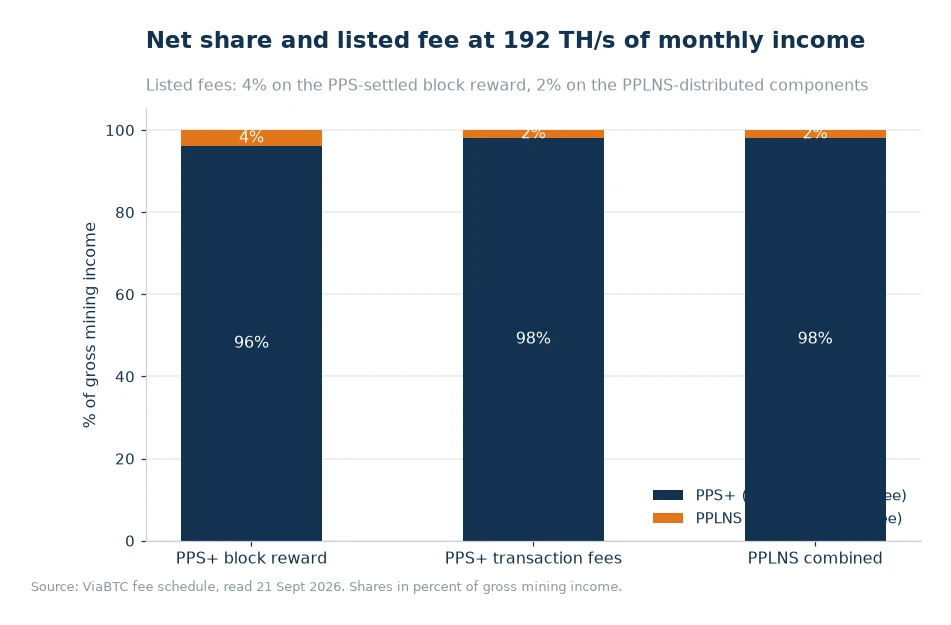
Three machines are enough to make a statement worth reading line by line and few enough that every line can be traced. At 192 TH/s the gross credit runs about 0.00008608 BTC a day, $7.29 at $84,692, of which the listed 4% on the block-reward component is $0.29 and the listed 2% on the PPLNS-distributed components is $0.15.
Key takeaways
- 192 TH/s earns about 0.00008608 BTC a day, or $7.29 gross and roughly $7.00 net at the listed 4%.
- Give each machine its own worker name; a merged worker hides which unit is underperforming.
- A statement line that moves by more than 3% without a hashrate change deserves a query the same week.
- The transaction-fee component is the part that varies most between months, so compare it before the total.
Why three machines make the statement harder
One machine produces a single number that can be checked against a single calculation. Three produce a total that can be right for the wrong reasons: two machines running well and one running at half output looks like a normal day with a slight dip. The total hides the composition, and composition is what a small operator can actually influence.
The remedy is administrative rather than technical. One worker name per machine, kept stable across reboots, turns the statement into three comparable series. It takes ten minutes at setup and saves an argument every time a fan fails. A shared worker name is the most common reason a small farm cannot locate a fault.
The four lines a statement should show
Whatever the layout of a particular statement, four quantities have to be findable, all of them on the PPS+ side of the account: the gross credit, the fee applied to the block-reward component, the fee applied to the transaction-fee component, and the net. If one of them cannot be located, the audit stops there and the question becomes a support ticket about formatting.
| Statement line | Expected | Band | Deviation usually means |
|---|---|---|---|
| Gross credit | 0.00008608 BTC / $7.29 | ±3% | A unit offline or throttled |
| Fee at listed 4% | $0.29 | ±3% | Fee mix shifted, or a wrong base |
| Fee at listed 2% | $0.15 | ±3% | Transaction-fee share moved |
| Net credit | about $7.00 | ±3% | One of the lines above |
The band is generous on purpose. Share variance at three machines is real, and a farm this size that queries every 1% move will spend its time on support tickets. Three percent is roughly the noise floor of a day's credit, which makes it the right threshold for a question rather than an alarm.
Allocating a total across three workers
When the machines are identical, the division is trivial: each worker should carry a third of the total, and a worker that carries 28% while the others carry 36% is the one to look at. When they are not identical, divide by hashrate rather than by machine count, and keep a note of the rated figures beside the worker names.
This is also the reason to resist renaming workers after a repair. A renamed worker starts a new series, and the history that would have shown a gradual decline is lost. Prefix the name with a fixed identifier and let the rest of the label describe the location or the model.
The multi-currency wallet shows the credits that the allocation is checked against, so the statement and the wallet should agree worker by worker once the settlement has cleared. Where they do not, the difference is usually timing rather than error, and the timing window is one hourly cycle.
Worked example: the daily lines at 192 TH/s
Produce the four expected values from the network figures.
- Split 450 BTC across 1,003,000,000 TH/s and each terahash earns 0.00000044865 BTC a day.
- At 192 TH/s: 192 × 0.00000044865 = 0.00008614 BTC, carried as 0.00008608 at the chart's precision.
- Dollars: 0.00008608 × 84,692 = $7.29.
- Listed 4% on the block-reward component: 7.29 × 0.04 = $0.29.
- Listed 2% on the PPLNS-distributed components, on the same base for comparison: 7.29 × 0.02 = $0.15.
- Net after the 4% line: 7.29 − 0.29 = $7.00.
- Per worker, with three equal machines: 0.00002869 BTC each, or about $2.33.
The per-worker figure is the one to paste into the audit sheet. Three values near $2.33 is a healthy day; two at $3.50 and one at nothing is a machine that has been offline since the last reboot and a total that still looked plausible.
When the transaction-fee line moves
The block-reward component is stable from day to day, which makes the 4% line predictable. The transaction-fee component is not. On a quiet chain it is a thin slice and the statement barely notices it; on a busy one it can be a meaningful share of the block, and the 2% line grows with it while the 4% line stays where it was.
For a three-machine farm the practical consequence is that the total fee in dollars can rise in a busy month without any change to the rate or the hashrate. That is not an error, and recognising it prevents a support ticket that ends with an explanation of something you already knew. Compare the two fee lines separately before comparing the total.
A five-minute monthly routine
Once a month, open the statement beside the audit sheet and check four things. Gross against the expectation at current hashrate. Each worker against its share. The two fee lines against their bases. The net against the wallet. Four ticks, five minutes, and any exception gets a note rather than an investigation.
Then record the hashrate you actually ran, not the hashrate you bought. A machine that has been throttled for a fortnight is a fact the sheet should hold, and it is the fact that explains a whole quarter of slightly disappointing numbers. The Profit Calculator will convert that real hashrate into the figure the sheet expects, which keeps the expectation honest.
Reading the schedule against your own statement
The ViaBTC Pool Fees page is the reference for the two rates, and the value of reading it beside a real statement is that the abstract becomes a line you can point at. Two percentages on a web page are a policy; two percentages next to $0.29 and $0.15 are a cost you can decide about.
Do that once, carefully, at the start of a quarter. The schedule will not change often, but your hashrate will, and an audit sheet built around the actual numbers is the difference between running a small farm and hoping that a small farm is running.
Frequently asked questions
How much does the pool fee cost at 192 TH/s?
About $0.29 a day at the listed 4% on the block-reward component, and $0.15 if the listed 2% is applied to the same base. Against a gross of $7.29, the net lands near $7.00 before power.
Should each machine have its own worker name?
Yes. Three machines on one worker name produce a total that cannot be attributed, so an underperforming unit stays invisible. Separate names cost ten minutes at setup and make every later comparison possible.
Why is the fee in dollars different from last month?
Either the hashrate changed, the price of bitcoin moved, or the transaction-fee share of the blocks changed. Check the gross first, then the two fee lines separately, since a busier chain raises the 2% line without touching the 4% line.
Audit the small farm while it is still small
Three machines is the easiest size at which to build a habit that survives thirty. Name the workers, write the four expected lines, check them monthly. When the farm grows, the sheet grows with it, and the questions that arrive with scale will be about tariffs and contracts rather than about which machine went quiet.
Sources: ViaBTC pricing, wallet and calculator pages. The published schedule applies 4% to the block-reward component and 2% to the PPLNS-distributed components, read 21 Sept 2026. Chain inputs read 21 Sept 2026: network hashrate 1,003 EH/s, difficulty 132.76 T, subsidy 3.125 BTC per block, BTC $84,692. Published 24 Oct 2026[1].