A machinery sourcing specification should describe the job the equipment must perform, the conditions in which it will operate, and the evidence that will count as acceptance. When buyers state only a machine category or headline capacity, suppliers can quote different configurations that appear comparable but leave important assumptions unresolved. A reviewable specification makes those assumptions visible before a purchase order fixes the scope.
Key takeaways
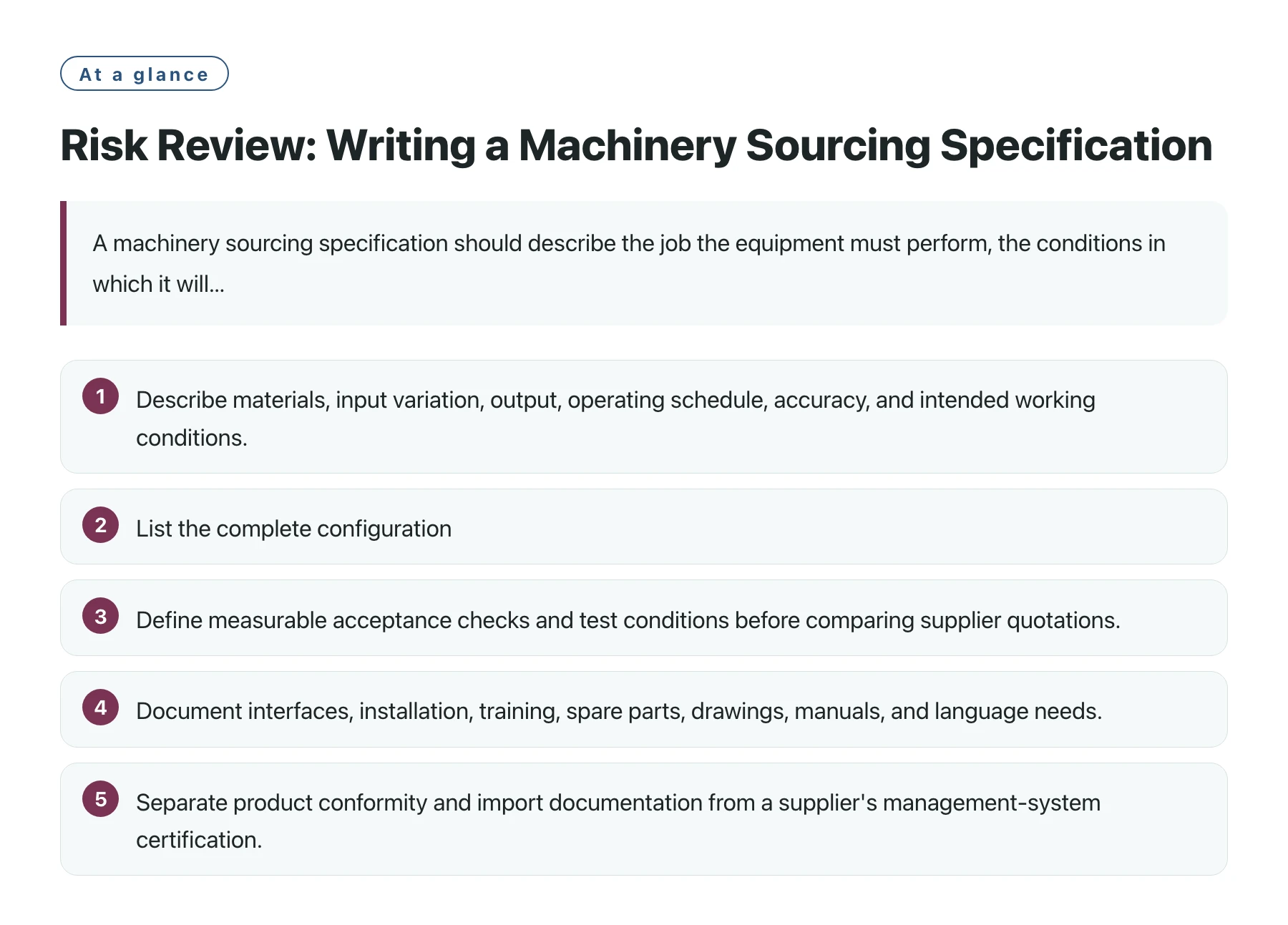
- Describe materials, input variation, output, operating schedule, accuracy, and intended working conditions.
- List the complete configuration, including tooling, controls, utilities, guarding, software, and accessories.
- Define measurable acceptance checks and test conditions before comparing supplier quotations.
- Document interfaces, installation, training, spare parts, drawings, manuals, and language needs.
- Separate product conformity and import documentation from a supplier's management-system certification.
- Turn open points into named actions, dates, and contract terms before production begins.
A machine is not purchased as a catalog description alone. It arrives with a configuration, documentation set, installation needs, and operating assumptions that determine whether it can perform in the buyer's process. A sourcing specification helps engineering, procurement, suppliers, inspectors, and the receiving team discuss the same equipment using the same revision and acceptance criteria.
Describe the production task in measurable terms
Start with the material or workpiece that enters the machine and the result that must come out. Include relevant material ranges, size variation, hardness or other known properties, and any preparation required before processing. State the required output in the unit that matters to the business, such as completed parts per shift or a defined process range, and explain the assumptions behind that figure. A throughput number without a stated material, operator, setup, or operating condition is difficult to compare across offers.
Describe the operating pattern: expected hours, shifts, changeovers, cleaning, ambient conditions, available floor area, access for maintenance, and nearby equipment. Identify the required accuracy, repeatability, surface condition, or other performance characteristics and say how each will be measured. If the team has a reference part or current process, attach drawings and samples with revision dates. Label preliminary values as provisional so a supplier does not mistake them for approved production limits.
A short operating scenario is often more useful than a broad label such as 'high capacity': explain the material, start condition, target result, and conditions under which the result must be demonstrated.
Name the exact machine configuration
Request a quotation for an identified model and configuration, not merely a machine family. List the main unit, control platform, motors, tooling, fixtures, sensors, guards, safety devices, included software, licenses, and accessories. Specify electrical supply and frequency, compressed air, cooling, extraction, or other utilities where relevant. State which components are included in the quoted price and which are optional, supplied by the buyer, or installed by another contractor.
Ask suppliers to mark deviations from the requested configuration in a response schedule. A clear exception list lets the buyer distinguish a compliant offer from a proposal that substitutes a different control, tool, material, or operating range. When a substitute is acceptable, record the reason, effect on performance, and approval status. Do not let a change in a drawing, model code, or component pass through as an informal email with no link to the purchase revision.
Set acceptance criteria before quoting
For each critical requirement, specify a method of demonstration, a result limit, and the conditions under which it will be measured. An acceptance test might include dimensional checks, a cycle-time observation, a sample run, alarm and interlock checks, or a review of calibration records. The method must fit the requirement: a no-load run cannot establish behavior under production conditions, and a visual check cannot establish measurement accuracy. If the equipment is too large to reproduce the final operating setup at the factory, agree on which parts of the test can be observed there and which require site commissioning.
Distinguish factory tests from installation and site acceptance. State who supplies test material, tooling, operators, utilities, measurement equipment, and translation. Define how many runs or samples are needed if the equipment needs warm-up or setup. Record unresolved results and specify whether corrective work, retest, or a documented deviation is required before shipment or final acceptance.
If a quality-system certificate appears in the supplier's offer, read it within its stated scope. ISO explains that ISO 9001 sets requirements for an organization's quality management system; it does not prescribe one universal way to run an organization.[1] Such a certificate may inform questions about process control, but it does not demonstrate that a specific machine meets the buyer's performance or safety requirements.
Specify interfaces and installation responsibilities
Machines often fail to fit an existing line because interface details were left to installation. Identify footprint, foundation or anchoring needs, infeed and outfeed heights, guarding boundaries, data connections, communication protocols, exhaust, drainage, and access clearances as applicable. Ask for the latest layout and connection drawings, and name the stage by which the supplier must submit them. If another machine or building contractor provides an interface, identify the party that checks compatibility.
List what the supplier will provide for startup: installation supervision, commissioning, operator training, maintenance instruction, software setup, or remote support. State the expected language of manuals and labels, the format and revision of electrical and mechanical drawings, and whether editable copies are required. If installation is by the buyer's team, request the prerequisite checklist and confirm which tools, test equipment, and qualified personnel are needed before shipment arrives.
Connect records and spare parts to the machine
Request a document index tied to the machine's model and serial number. It may include operation and maintenance manuals, wiring diagrams, parts lists, software versions, inspection or test reports, lubrication schedules, and safety information, depending on the equipment and destination. The specification should state whether documents are due with the quotation, before testing, before shipment, or with the delivered machine. A generic manual for a related model may omit the exact options ordered.
Ask for a recommended spare-parts list with part identifiers, lead-time assumptions, and which items are needed for routine maintenance versus an unexpected stoppage. Identify proprietary software, passwords, dongles, licenses, and backup or restore procedures required to keep the machine operating. Avoid assuming that a component's commercial availability or compatibility will remain unchanged; write down the revision and any agreed substitution process.
Treat compliance and shipping as separate workstreams
Determine the destination market and identify product-specific legal, electrical, environmental, or safety requirements that apply to the machine. The supplier can provide technical documents and test evidence, but the buyer should confirm which party is responsible for conformity assessment, declarations, labels, technical files, and local registration. A management-system certificate does not replace this product-level review.
For U.S. imports, Customs and Border Protection's importer guidance describes the importer's responsibilities and records to understand for an entry.[2] Buyers shipping elsewhere should confirm local customs, tariff classification, product rules, and documentation with the relevant authorities or a qualified adviser. State the agreed shipping arrangement, packing standard, shipment marks, weights and dimensions, insurance responsibility, and delivery point so the quotation can be compared on a defined basis.
Link each required document to an owner and due date. If a document is a condition for shipment, state the consequence of missing or incomplete paperwork rather than leaving the requirement as a general note in an inquiry email.
Use a controlled revision during supplier comparison
Give the inquiry package an identifier and revision date. Ask every supplier to quote against that version and return a completed exception schedule. When the specification changes, issue a new revision and summarize the changes that may affect price, lead time, tooling, test scope, or safety. This creates a defensible comparison and reduces the chance that the selected supplier priced a different machine from the one the buyer expected.
Before order release, consolidate accepted deviations and open items into the contract or its appendices. Set a change-approval route for drawings, materials, software, and subcontracted work. Teams coordinating factory communication or inspection schedules can review Learn more about sourcing support, then assign technical approval, commercial approval, and acceptance responsibilities to named people on the buyer's side.
Sources
Frequently asked questions
How detailed should a machinery sourcing specification be?
Detailed enough for suppliers to quote the same configuration and for the buyer to verify the critical results. State operating conditions, interfaces, included items, test methods, limits, and document requirements; mark unresolved values as open.
Should acceptance testing happen at the factory or at the buyer's site?
It depends on what can be reproduced at each location. Define factory checks, installation checks, and site acceptance separately, including test conditions, responsibilities, and how unresolved results are handled.
Does an ISO 9001 certificate prove the machine meets my requirements?
No. It concerns an organization's quality management system within a stated scope. The specific machine still needs product-level evidence, tests, and contractual acceptance criteria.
What if a supplier proposes an alternative component?
Ask the supplier to document the deviation and its effect on function, compatibility, safety, maintenance, price, and schedule. Approve it in the controlled specification or contract before production uses it.