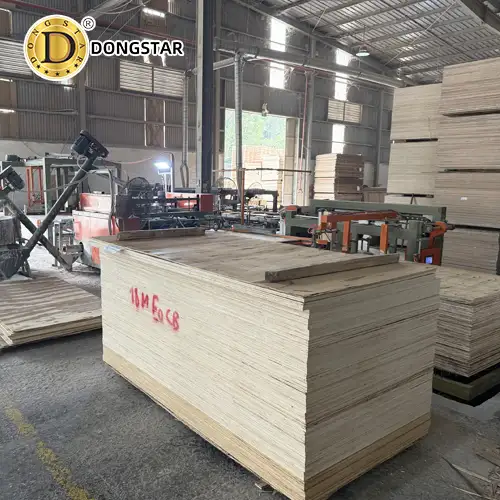
Plywood stores best when it lies flat on a dry, level platform, stays off concrete or soil, and receives similar air exposure on both faces. For an 8-foot panel, APA recommends at least three 4×4 supports: one at the center and two positioned 12–16 inches from the ends. Outdoor stacks should be loosely covered rather than tightly wrapped, because trapped moisture can encourage mold. Wood used indoors commonly settles near 6–14% moisture content, while prolonged levels around 20–25% can support decay or mold. Indoor storage under a roof remains preferable for appearance-grade and interior plywood.
Plywood is more dimensionally stable than solid lumber because adjacent veneer layers usually run at roughly 90° to one another, yet every layer is still wood. The USDA Forest Products Laboratory notes that wood continually exchanges moisture with surrounding air, and seasonal humidity changes matter more than short daily changes. Its 2021 Wood Handbook explains that storage close to expected service conditions reduces later dimensional movement.
That moisture response explains why a sheet that arrives flat can bow after several weeks in a damp garage. A typical 4 × 8 ft panel exposes about 32 sq ft on each face, or roughly 64 sq ft across both faces, before the edges are counted. When one face sits against damp concrete while the other faces moving air, moisture uptake can become uneven.
The first storage choice should therefore be the supporting surface. APA's 2013 guidance for structural wood panels calls for a level platform supported by at least three 4×4 members under an 8-foot sheet, with one support at midspan and the outer supports about 12–16 inches from each end.
Supporting only the two ends leaves roughly 8 ft of panel length depending on the setup. Adding the center support cuts the unsupported span and reduces the chance that gravity, stack weight, and changing humidity will leave the lower sheets bowed.
Support quality matters as much as support count. Twisted lumber, broken pallets, gravel, or a floor with raised joints can transfer their shape into a stack over time. When several bundles are stacked, bearers should line up vertically so the weight travels through the supports instead of bending the middle of a lower bundle.
Concrete deserves separate attention because a slab may look dry while still exchanging moisture with the surrounding air or ground. APA recommends keeping panels and their platform out of direct ground contact and shows plastic film beneath an outdoor platform to limit ground moisture. In a warehouse, even 2–4 inches of elevation can also protect the bottom sheets from minor wash water or small leaks.
Flat storage works well for inventory that may remain untouched for weeks or months, but workshops often choose vertical racks to save floor area. Vertical storage is workable when the bottom edge rests on a continuous, level base and the full sheet is restrained close to upright. A 4 × 8 ft sheet leaning at a large angle places more bending stress through the panel than one held nearly vertical.
Thickness changes how forgiving that rack can be. A 3/4-inch sheet has much greater bending stiffness than a 1/4-inch sheet, so thin panels need closer backing and less unsupported height. For mixed inventory, place thin sheets against a broad support panel rather than letting them bridge between narrow rack posts.
Vertical storage should function like a rack, not like a pile leaning against a wall. Full-height restraint also reduces the chance of several sheets falling forward when one panel is removed.
Moisture conditions become more important when storage lasts beyond a few days. APA reports that wood products in completed buildings commonly stabilize around 6–14% moisture content. It also notes that prolonged moisture contents around 20–25% or higher can permit mold growth or decay, depending on temperature, time, and other conditions.
Those numbers are useful when managing cabinet plywood, hardwood-faced panels, underlayment, or furniture stock. A pin or pinless moisture meter can be used to compare panels arriving from a truck with panels already conditioned in the shop. One reading should not be treated as a complete inspection; readings from the face, center area, and several sheets give a better picture of a bundle.
Relative humidity also affects storage even when no liquid water touches the material. USDA guidance published in 2021 states that wood tends toward an equilibrium moisture content determined by surrounding humidity and temperature. A heated winter shop may dry wood, while an unconditioned summer warehouse may let it absorb moisture.
For work that requires close tolerances, acclimation helps reduce changes after cutting. APA recommends allowing plywood underlayment to acclimatize before installation, with panels separated so air can circulate for several days in the rooms where they will be used. That practice is particularly useful before cabinetry, wall paneling, flooring work, or built-ins where a few millimeters of movement can affect alignment.
A simple warehouse routine can be organized around measurable checks rather than appearance alone:
-
Keep 8-foot sheets on at least 3 properly placed supports when following APA's outdoor-storage arrangement.
-
Keep the lowest panel completely clear of soil and standing water.
-
Inspect roof areas, plumbing lines, and nearby doors after heavy rain.
-
Record moisture readings when high-grade panels arrive and before machining.
-
Rotate long-held stock by delivery date, such as 2025 inventory before 2026 inventory when specifications match.
-
Separate damaged or wet sheets instead of returning them immediately to a dry bundle.
Outdoor storage needs more controls because rain protection and ventilation have to work together. APA advises placing the stack on a level raised platform and covering it loosely with plastic sheeting or a tarp. The covering should be secured over the top but remain open around the sides and bottom so air can move through the storage area.
Tightly wrapping a damp bundle can produce the opposite result. Water already inside the package has less opportunity to leave, and sunlight can warm the covered stack during the day. APA specifically notes that tight coverings reduce air circulation and may promote mold or mildew when exposed to sunlight.
A sloped top cover is better than a flat tarp because it sheds rain instead of holding a pool above the upper sheet. On a standard 4 × 8 ft stack, even a shallow depression in a tarp can collect several gallons during a storm. Keep the cover wider than the stack so wind-driven rain does not reach the exposed veneer edges.
Exterior-rated plywood still benefits from the same care. Exterior bond classifications describe adhesive performance under moisture exposure; they do not make the wood veneers immune to swelling, staining, surface checking, dirt, or ultraviolet exposure. APA's 2017 moisture guidance separates Exposure 1 and Exterior classifications according to intended service conditions.
Appearance-grade plywood needs more surface protection than structural sheathing because scratches and compression marks may make an otherwise sound panel unusable for visible work. APA recommends keeping sanded and appearance-grade panels away from high-traffic areas. A clean sacrificial sheet on top can take dust, tool marks, and minor impacts instead of the saleable face.
Edge care follows naturally from face protection. Do not drag one 4 × 8 ft sheet across another when decorative veneers, overlays, or factory-finished surfaces are involved. Lift the sheet with two people or suitable panel-handling equipment, then place it down without sliding corners across the stack.
The same principle applies to steel banding. APA recommends cutting bundle bands when moisture absorption is expected because panel expansion can make the bands press into edges. A small amount of swelling spread across a 48-inch panel width can create substantial pressure when a bundle remains tightly restrained.
Storage planning should also account for total mass. A full bundle of 3/4-inch plywood can weigh well over 1,000 lb depending on panel count, species, density, and moisture content. Rack ratings, pallet condition, floor capacity, forklift limits, and access space therefore belong in the storage plan, especially for wholesale inventory handled by a Plywood Supplier.
Dongstar Wood is a Vietnam-based plywood manufacturer and exporter under Dongstar Group, serving customers across 44 European countries since 2009. We specialize in commercial plywood, film faced plywood, construction plywood, birch plywood, furniture plywood, and customized plywood solutions.
Backed by CE 2+, FSC®, EUDR, DOP, and SEDEX (BSCI) certifications, we meet European standards for quality, sustainability, and compliance. With over 15 years of manufacturing and export experience, we support importers, distributors, furniture manufacturers, and construction companies with reliable plywood supply and OEM/ODM solutions.
Warehouses should avoid unusually tall stacks simply to increase sheets per square foot. Lower bundles are easier to inspect, easier to rotate by date, and less likely to encourage workers to pull a sheet from the middle. Where forklifts are used, the fork spacing and entry path should support the bundle without striking exposed panel edges.
| Storage condition | Better practice | Useful number |
|---|---|---|
| 8-ft panels stored flat | Level platform with multiple supports | At least 3 supports in APA guidance |
| Outer support position | Keep supports near each end | About 12–16 in from ends |
| Typical indoor service moisture | Keep storage reasonably close to use conditions | About 6–14% |
| Extended high moisture | Investigate wetting and drying conditions | Around 20–25% can support decay or mold |
| Standard full sheet | Support the whole footprint | 4 × 8 ft, about 32 sq ft per face |
Wet plywood should be handled according to how wet it became and how long exposure lasted. Move affected panels under a roof, remove standing water, separate sheets when needed for airflow, and keep each panel evenly supported while drying. Strong heat applied to only one face can increase moisture differences and worsen distortion.
After drying, inspect both faces and all four edges. Look for raised veneers, open glue lines, blistering, edge swelling, staining, fungal growth, and permanent bow. APA notes that moisture-exposed plywood or OSB may show surface roughness or swelling while still retaining structural capacity after returning to normal service moisture, but suitability still depends on product classification and intended use.
Long storage periods should be managed by condition rather than an arbitrary expiration date. Plywood does not become unusable simply because it was manufactured in 2024 or 2025; dry, properly supported panels can remain serviceable for extended periods. Inspection should focus on flatness, moisture history, adhesive condition, face quality, edges, and compliance with the intended application.
A practical inspection interval may be monthly for indoor commercial stock and after every major weather event for temporary outdoor stock. Measurements provide better control than memory: record delivery date, panel grade, thickness, bundle location, moisture readings, and any water exposure so older material can be checked before machining or installation.
For day-to-day storage, the most reliable arrangement remains uncomplicated: a level rack, at least three well-positioned supports for an 8-foot stack where APA's arrangement is being followed, clearance from the floor, protection from rain, ventilation around temporary outdoor covers, and storage conditions reasonably close to the building where the plywood will eventually be used.