A first-time founder asking for a custom scent is usually offered two routes: adapt an existing composition towards the brief, or develop a new one from a blank page. The first is quicker and cheaper and is rarely exclusive; the second costs more and takes longer but produces something that belongs to the brand. The right choice depends on how much of the brand's value sits in the scent and how much runway the launch has, not on which route sounds more serious.
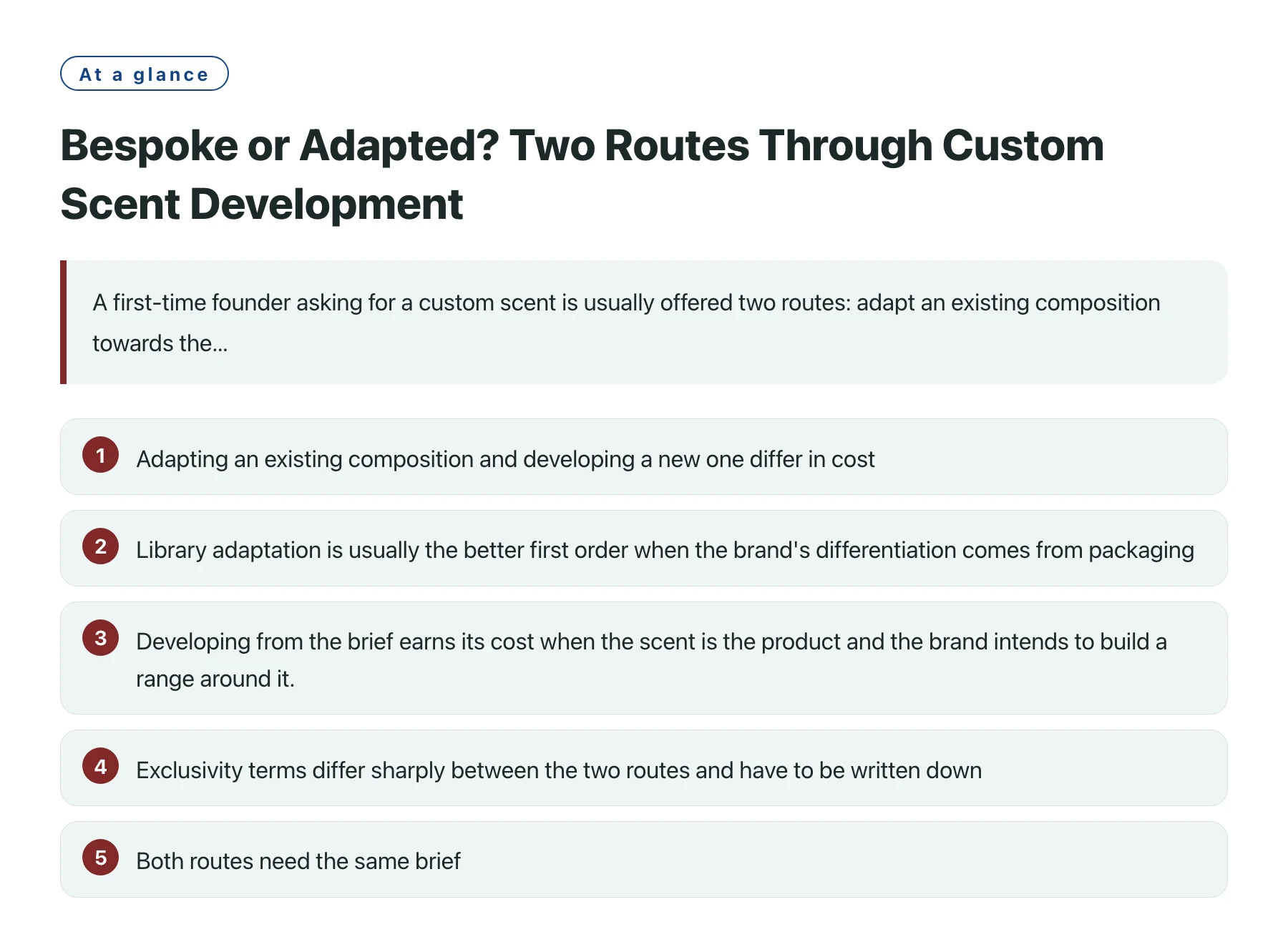
Key takeawaysAdapting an existing composition and developing a new one differ in cost, timeline and exclusivity rather than in quality. · Library adaptation is usually the better first order when the brand's differentiation comes from packaging, price or channel rather than from the scent itself. · Developing from the brief earns its cost when the scent is the product and the brand intends to build a range around it. · Exclusivity terms differ sharply between the two routes and have to be written down, because a library composition is rarely exclusive by default. · Both routes need the same brief, the same evaluation discipline and the same retained reference samples; only the development work changes.
The phrase “custom perfume” covers both routes, which is why two suppliers can quote very different prices against the same brief and both be honest. One is adapting a composition it already holds. The other is starting from an empty page.
This comparison is written for a founder placing a first order. It treats the two routes as commercial choices with technical consequences, rather than as a hierarchy in which one is the real thing and the other is a compromise.
The two routes, side by side
| Question | Route A: adapted composition | Route B: developed from the brief |
|---|---|---|
| Where the composition comes from | An existing formula, adjusted towards your brief | A new composition written for the project |
| Time to first sample | Often short, because the starting point already exists | Longer, because the direction has to be built |
| Cost structure | Lower development cost, and sometimes very little of it | Development time and trial materials are billed or absorbed |
| Exclusivity | Rarely exclusive unless it is negotiated and paid for | Exclusivity can be defined in the contract from the start |
| Fit to the brief | Close, if the library holds something near your direction | As close as the brief and the number of rounds allow |
| Main risk | The scent may resemble something already on the market | A direction may not land, and every extra round costs money |
| Best stage | First order, test launch, tight calendar | Hero scent, range built around it, longer runway |
Neither column is the better one. The point is that the two routes differ on nearly every commercial dimension, so they cannot sensibly be compared on price alone.
What each route feels like in practice
Route A: adapting a composition
This process usually starts with a conversation and a set of reference smells rather than a written brief. The supplier proposes two or three existing compositions that sit near the target, the brand reacts, and the formula is adjusted at the edges: less sweetness, a stronger opening, a drier drydown.
The limitation is structural. An adapted composition is built on someone else's skeleton, and there is a point beyond which it cannot be moved without effectively becoming a new formula, which is where Route A's advantages disappear. Reaching that point mid-project is an expensive way to discover you wanted Route B.
A custom perfume manufacturer in China will normally offer both routes, so the useful question at the very start is which one the supplier is actually pricing. Proposals rarely say, and the difference shows up later as a surprise.
Route B: developing from a brief
This route starts with a written brief covering the market, the user, the occasion, the price tier, the notes to avoid and the references that define the direction. A perfumer proposes a direction, samples follow, and each round is judged against the brief rather than against a competitor's bottle.
It consumes more calendar time and more money, and its value is concentrated in the moments where the brand makes decisions. A founder who cannot evaluate samples consistently gets less from Route B than from Route A, because steering is the whole advantage of the route.
It also produces more documentation, which is an underrated benefit. A developed composition with a written specification and retained references is easier to repeat, protect and hand over than an adapted one. Picking up the vocabulary the industry uses to describe and sell scent is worth the effort first [1].
The two questions that decide it
Ask what the customer is really buying. If the answer is a well-priced scented product in which packaging and channel do the work, Route A is usually enough and the saving is genuine. If the answer is the scent itself — the reason someone returns, the reason a review mentions it — then the brand is buying Route B whether or not it has admitted that yet.
The second question is about runway. Route B needs time for rounds that may not converge, so a brand launching in eight weeks should not choose it. A brand launching next year, with three more scents planned, probably should.
Route B is essentially a decision to work with a factory that develops and produces the scent, and the quality of that relationship shows in how well the brief survives the first round. Understanding the R&D process behind wholesale fragrances in advance makes the sampling stage far less mysterious to manage.
Project references are worth reading too, though with a caveat: case studies rarely say which route was used, so read the brands behind these scents for the type and scale of the projects rather than for the process behind them.
Terms to agree whichever route you take
Exclusivity is the term most often left vague. On Route A, assume the composition is not exclusive unless the contract says it is and the price reflects it. On Route B, exclusivity is easier to define, but it still has to be described precisely: exclusive to whom, in which markets, for which product categories, and for how long.
Ownership of the formula is a separate question from exclusivity of use, and the protections available differ between jurisdictions. Both should be settled in writing before development begins, because negotiating them afterwards turns a technical conversation into a commercial one [2].
Sampling terms deserve the same treatment: how many rounds are included, what an extra round costs, how long the brand has to respond, and what happens if the two sides cannot agree on a direction. Three of those four items are usually missing from a first proposal.
Material limits apply to the finished product regardless of which route produced the composition, and an original formula is not exempt from them. Dosage, product type and market all feed into that check, and it belongs in the project plan rather than in the launch week [3].
Finally, agree what happens to the specification and the retained samples at the end. Whichever route was taken, the brand should walk away with a document it can produce against and a physical reference it can compare against.
Sources
- The Fragrance Foundation —— A non-profit organisation for the fragrance industry, running perfumery education programmes and industry recognition.
- WIPO — World Intellectual Property Organization —— The UN agency for intellectual property; resources on industrial design and patent protection relevant to product and packaging design.
- IFRA Standards Library (International Fragrance Association) —— The IFRA Standards Library lists the restrictions the fragrance industry applies to individual fragrance ingredients, based on safety assessments; it is the reference point for compliant fragrance formulation.
Frequently asked questions
Is an adapted composition a lower quality product?
No. It is a different commercial arrangement. Quality depends on the composition and on the production, not on whether the starting point already existed.
How much more does bespoke development cost?
It varies too widely for a general figure. Ask what the development fee covers, how many rounds are included, and what an additional round costs, then compare that against the adapted route.
Can we start with Route A and move to Route B later?
Yes, and it is a common path: launch on an adapted composition, then commission a developed hero scent once the brand has an audience and clearer direction.
Will an adapted composition be exclusive to us?
Usually not by default. Exclusivity on a library composition can sometimes be bought, but it has to be written into the agreement and priced.
Which route should a first order use?
If the calendar is short and the scent is not the main selling point, adapt. If the scent is the reason the brand exists, develop, and give the project enough time to converge.